Value Iteration and Policy Iteration: Many Small Steps or a Few Big Jumps
An interactive live film: in the 3D space of value functions, value iteration creeps toward V* by a factor gamma per step, while policy iteration jumps there in a few exact policy evaluations. Find the gamma where value iteration needs fifty steps.
Narration
A small decision problem: three states, two actions each. Every value function is a point in this space, one coordinate per state, and the green star is the optimal value function.
Value iteration starts at zero and applies the Bellman optimality operator again and again. Each blue dot is one step, and each step closes the distance by a factor gamma.
Policy iteration alternates two moves. It evaluates the current policy exactly, by solving a linear system, and then improves the policy greedily, state by state.
So its orange path jumps from one policy's value straight to the next, and lands exactly on the star after a few jumps.
Because there are only finitely many deterministic policies, and each improvement strictly helps, policy iteration must stop after finitely many rounds. Value iteration only gets there in the limit.
Your turn. Change gamma. Find the smallest gamma at which value iteration needs more than fifty steps to get within one hundredth, while policy iteration still needs only a few rounds.
Value iteration takes cheap steps that shrink by gamma; policy iteration takes expensive steps, each a linear solve, but very few of them.
More from Chapter 15
 Preview1:32The Discounted Return: Now or LaterChapter 15
 Preview1:39The Bellman Equation as a Linear SystemChapter 15
 Preview1:49Bellman Operator: A Contraction With One Fixed PointChapter 15
 Preview1:34Continuous-Time Markov Chains: Probability Flowing on a TriangleChapter 15
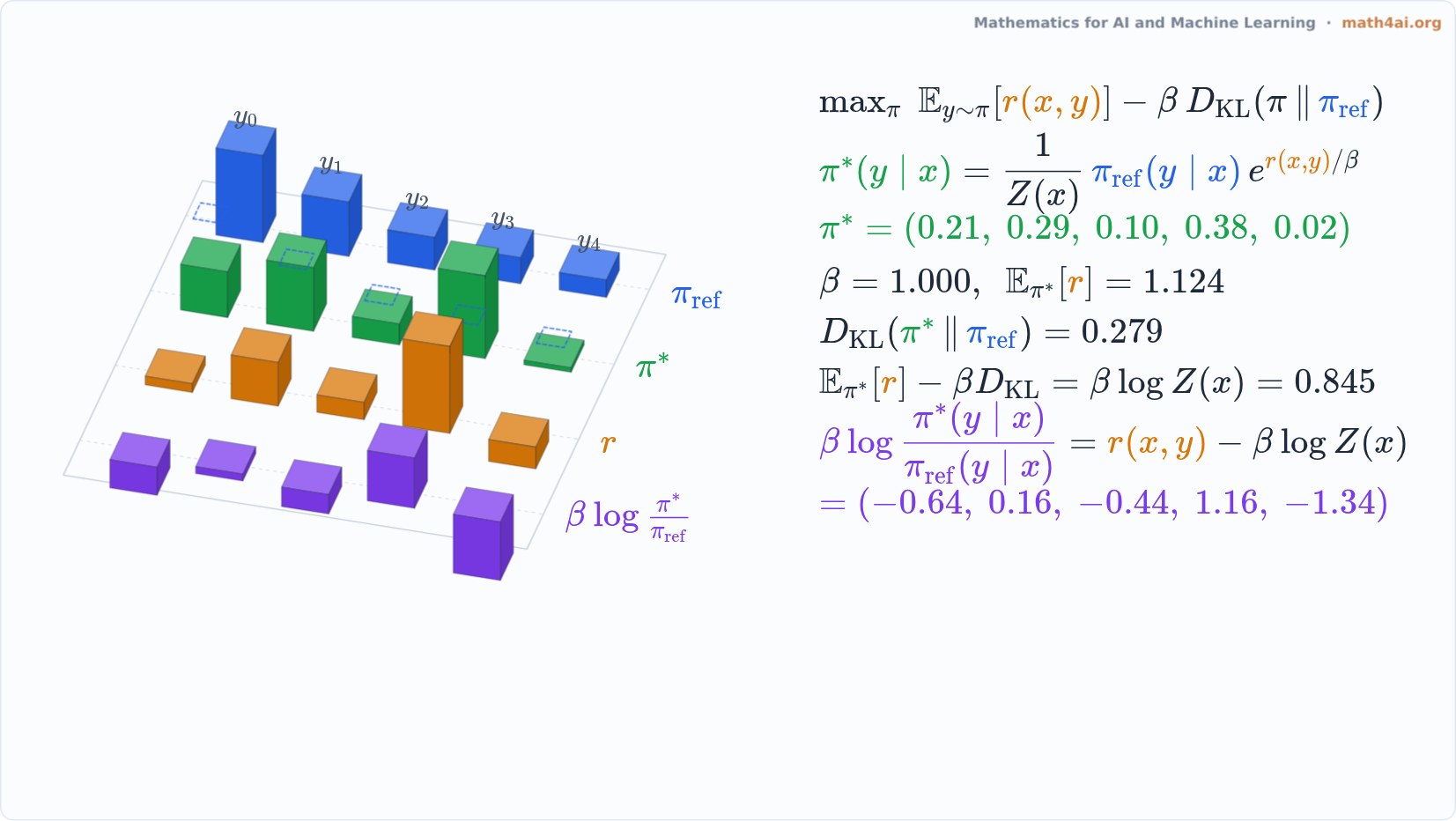 Preview1:58The KL-Regularized Optimal PolicyChapter 15
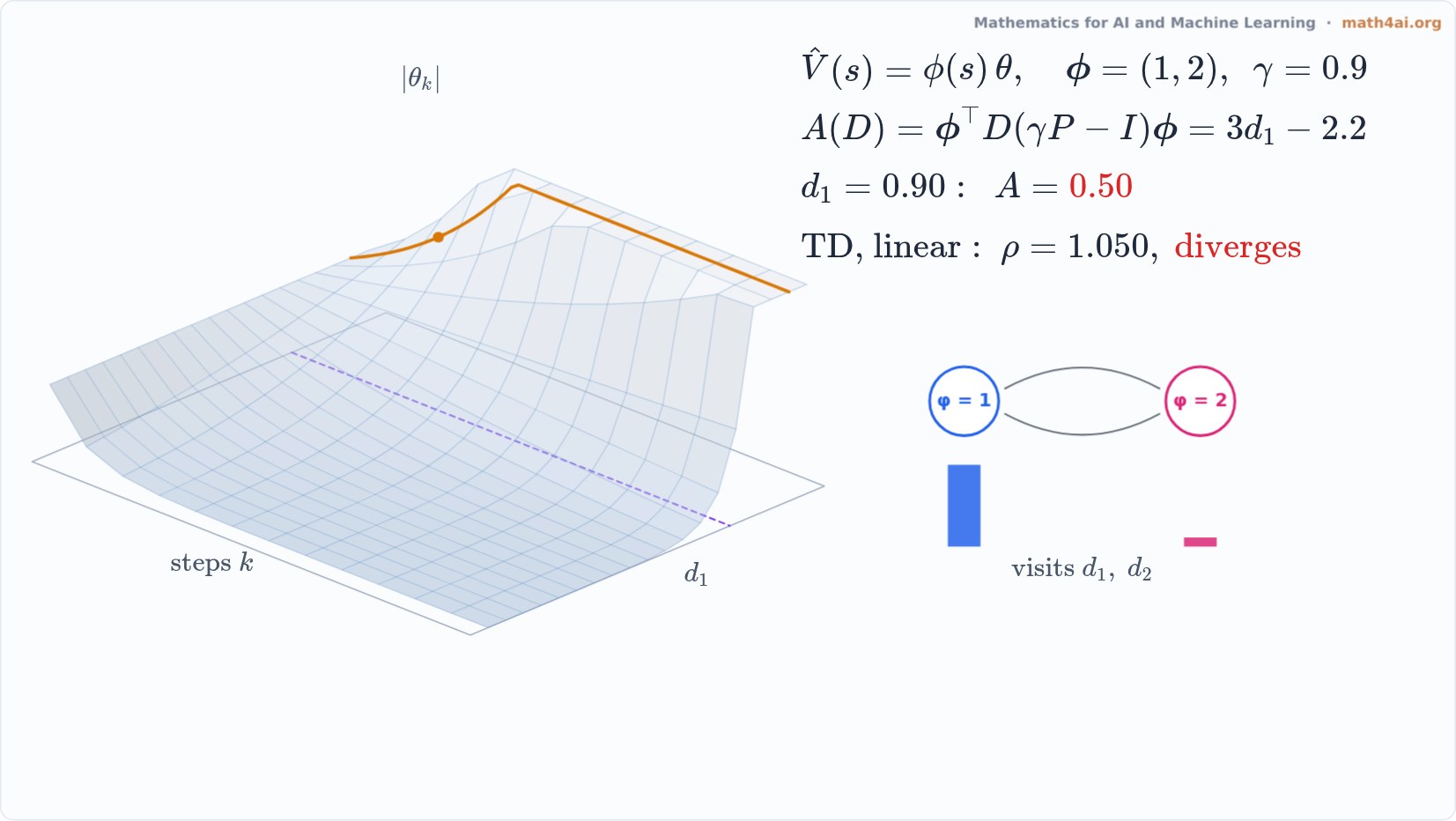 Preview1:51The Deadly Triad: When TD Learning ExplodesChapter 15