Brownian Motion: Rough Paths, a Spreading Bell, and dW Squared Equals dt
An interactive live film: two hundred Brownian paths over time with the bell N(0, t) above them in 3D; a wall at time t shows the histogram of W_t, and the sum of squared steps of one path stays close to t at every step size.
Narration
Brownian motion starts at zero and wanders. Here are many of its paths, with time running along the floor.
At any time t, the positions of the paths are Gaussian, with mean zero and variance t. Above the floor that bell is drawn for every time, and it spreads like the square root of t.
Stand a wall at one time. The histogram of where the paths cross it, in amber, matches the bell.
Steps over separate time intervals are independent, and a step over a length h has variance h. Make the time step smaller, and the paths get rougher, but they keep the same spread.
Now add up the squared steps of one path, up to time t. However fine the steps, the sum comes out close to t itself. In the limit, d W squared equals d t.
That is why ordinary calculus fails for these paths, and why Ito's lemma has an extra term.
Your turn. Drag the wall along the time axis, and change the time step with the slider.
Gaussian spread, independent steps, and a squared step that behaves like d t: those three facts drive every stochastic differential equation.
More from Chapter 19
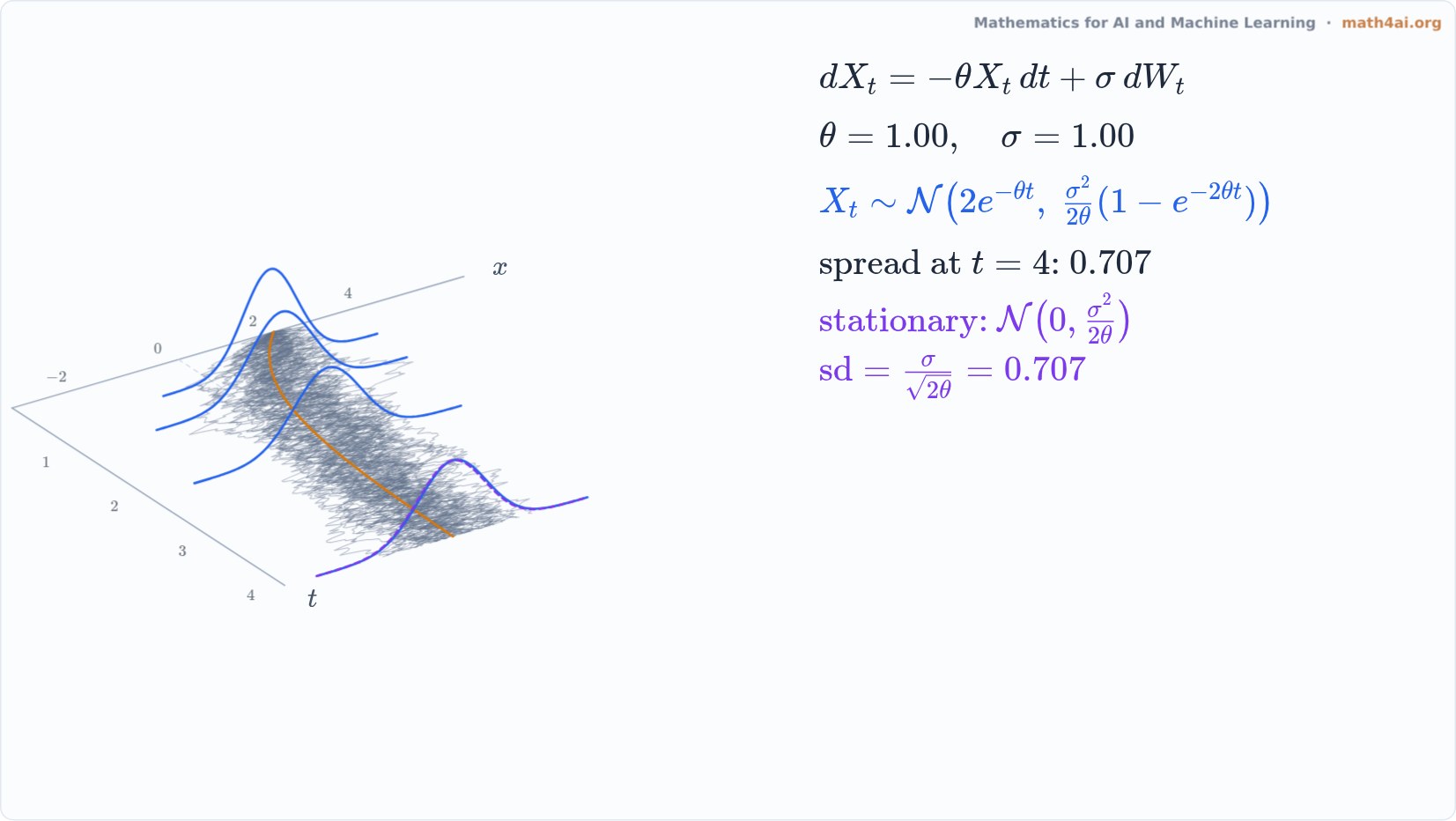 Preview1:17The Ornstein-Uhlenbeck Process: Brownian Motion on a SpringChapter 19
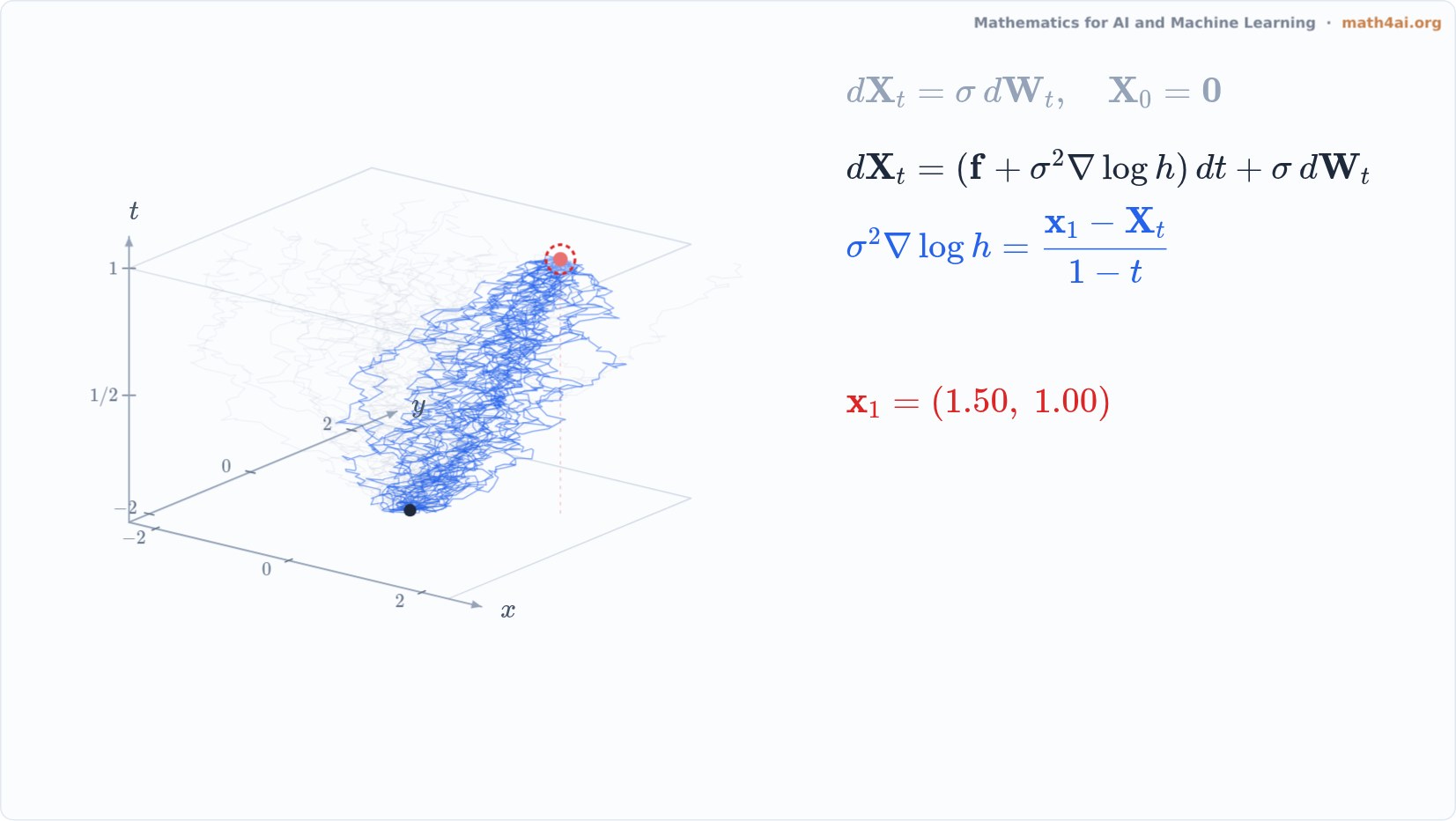 Preview1:29Conditioning a Diffusion on Its EndpointChapter 19
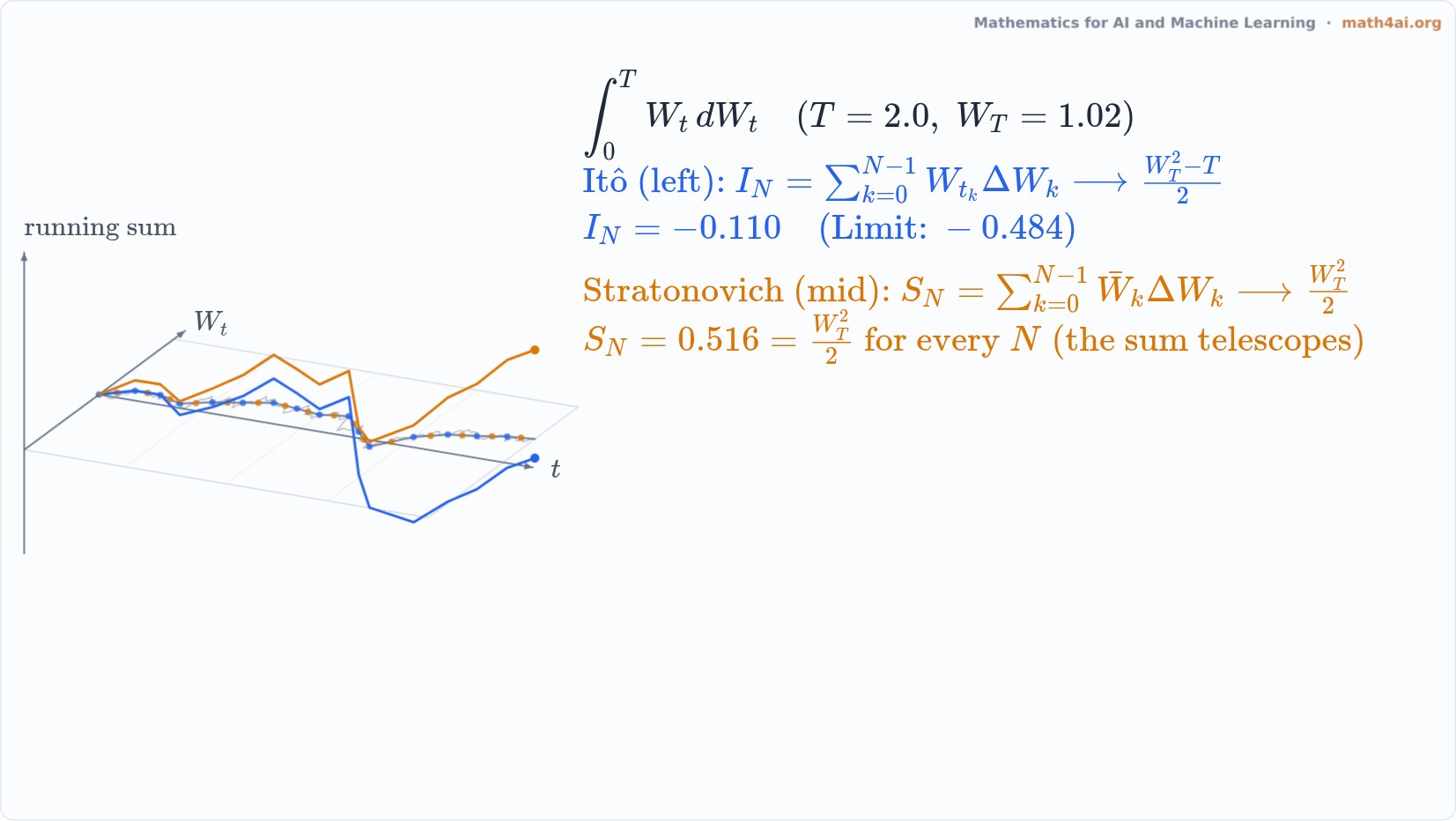 Preview1:46Itô vs Stratonovich: Left Endpoint or MidpointChapter 19
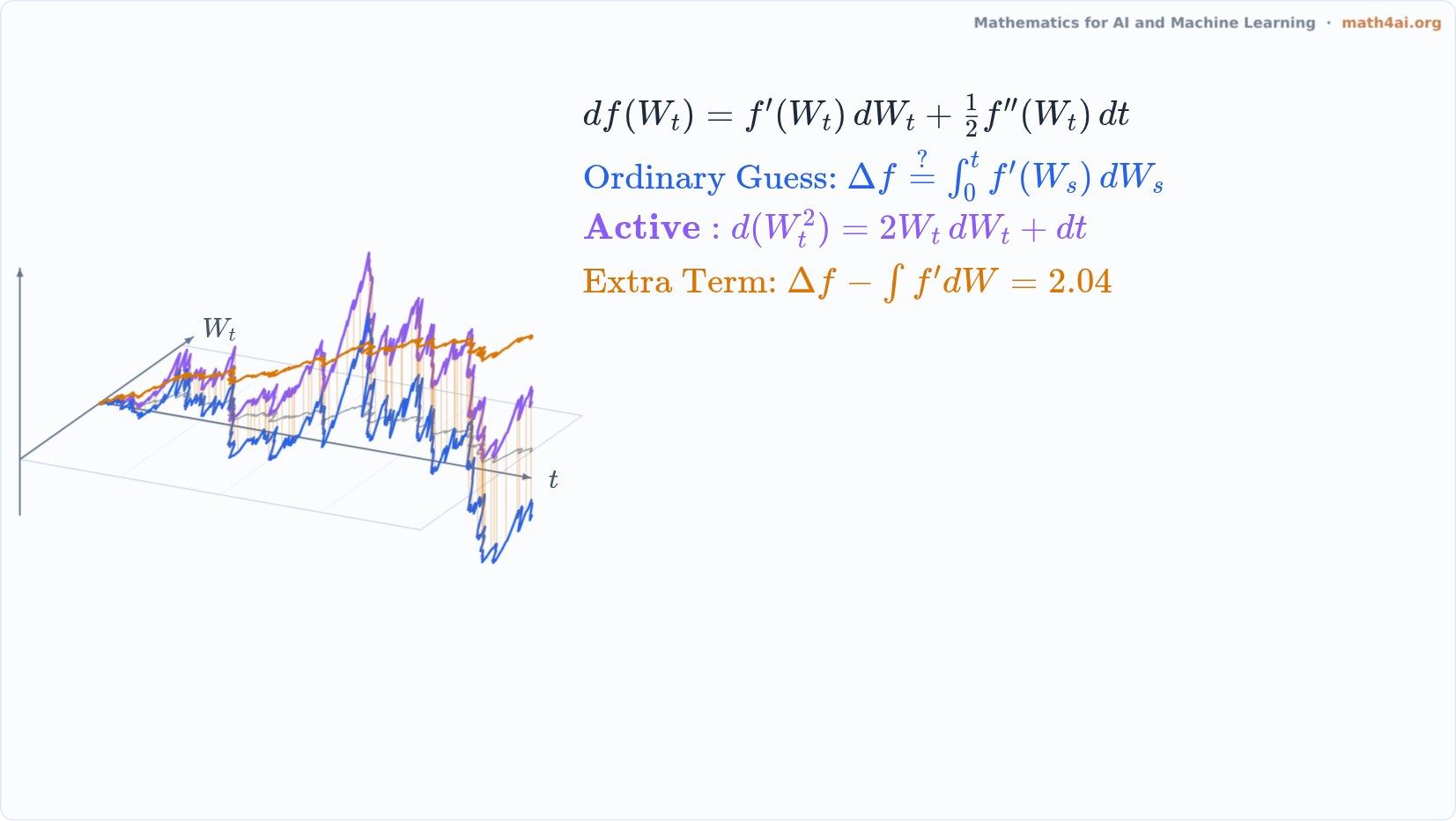 Preview2:01Itô's Lemma: The Extra Second-Order DriftChapter 19
 Preview1:56Euler–Maruyama: SDEs as Limits of AlgorithmsChapter 19